บทที่ 3 · แรงและกฎการเคลื่อนที่
Problem 3.37
หัวข้อ: แผนภาพวัตถุอิสระ (Free Body Diagram ; F.B.D.)
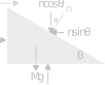
จากรูปด้านล่าง ถ้าไม่คำนึงถึงแรงเสียดทาน ต้องออกแรง F ขนาดเท่าใด เพื่อให้ วัตถุมวล m ไม่ไถลลงมาจากพื้นเอียงมวล M?


คำตอบ
\(F = (M + m)gtan\theta \;\blacksquare ; (3)Mg\)
\(F = (M + m)gtan\theta \;\blacksquare ; (3)Mg\)
ดูวิธีทำ
พิจารณา F.B.D. ของมวล m
a
จะได้ \(ΣF_{x}= ma_{x}\)
\(nsin\theta = ma\cdots \cdots (1)\)
\(nsin\theta\)
\(^{\theta}mg\) และ \(ΣF_{y}= ma_{y}\)
\(nncos\theta\)
\(ncos\theta - mg = m(0)\)
\(ncos\theta = mg\cdots \cdots (2)\)
\((1)/(2);\tan \theta =\frac{a}{g}\to a=gtan\theta \cdots \cdots (3)\)
พิจารณา F.B.D. ของมวล M
จะได้ \(ΣFa_{x}= ma_{x}\)
\(ncos\theta\)
n
\(F - nsin\theta = Ma\)
\(_{\theta}\)
\(nsin\theta\)
\(F - ma = MaF; (1)\)
\(F = (M + m)a\theta\)
\(F = (M + m)gtan\theta \;\blacksquare ; (3)Mg\)
N